Oven Repair
Why does my Viking oven stall 50 degrees short?
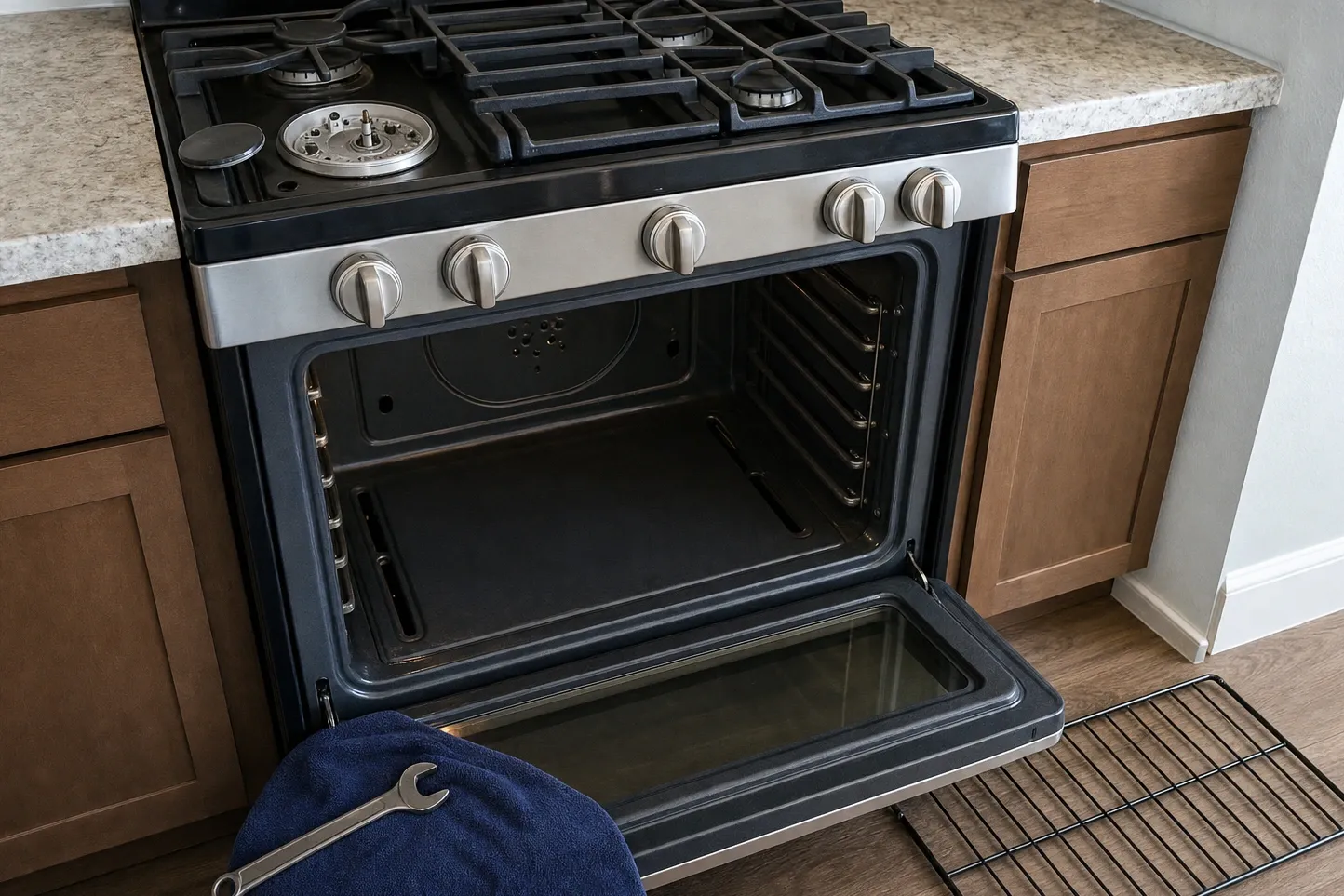
A stalling oven behaves in a very particular way. It climbs at a sensible rate for the first part of the preheat, slows, and then parks itself somewhere below what you asked for and sits there indefinitely. That is a different animal from an oven that is merely reading wrong, and the distinction is worth making on the doorstep, because the two have nothing in common once you get past the complaint.
An oven that reads wrong still settles. It finds a steady state and holds it, just at the wrong figure. An oven that stalls has run out of something, and no amount of patience will carry it the rest of the way.
What a cavity that stalls is telling you
An oven is an insulated box that leaks, and everything it does is a contest between the heat going in and the heat getting out. While there is more going in, the temperature rises. Where the two even out, it stops rising. Normally the control ends that contest early by cutting the heat at your number.
An oven that parks below your number has had the contest ended for it somewhere lower down. So there are only two possibilities worth entertaining: less heat is arriving than used to, or more of it is leaving. Every cause on the list below is one or the other, and the encouraging part is that you can often tell which camp you are in by listening and looking rather than by testing anything.
Elements, sensors and a door that no longer seals
Electric ovens usually have heat sources above and below, and they are not both used in every mode. If the one that does the baking has quietly failed while the other still works, the cavity can warm up convincingly and yet never complete the journey. Worth knowing: a failed heating element very often looks entirely healthy, with no break and no blistering to see.
On a gas oven, the burner is lighting later in each cycle than it once did, so the oven spends a greater share of every hour not heating at all. The oven still gets hot. It just cannot keep up with a setting that asks for more than it can now deliver in the time available.
Then there is the sensor. One that reads high tells the control the cavity has arrived when it has not, and the control dutifully stops adding heat. From the kitchen that looks identical to a weak element, which is why nobody good guesses between them.
Last, the box itself. A door that has dropped, or a seal flattened along one run, gives the cavity a permanent leak. On a mild afternoon the oven wins that argument. On a cold morning near the water in Venice or Marina del Rey it loses, which is why a few of these calls turn out to be seasonal rather than sudden.
What you can check safely
Start cold and listen. On a gas oven you are listening for the moment the burner catches and for how long you waited for it. On an electric one you are mostly listening for the fan and for nothing else happening at all.
Then try broil and bake separately and note which of them behaves. If one is fine and the other is not, say so when you call. Of everything a homeowner can find out without tools, that single fact narrows the answer furthest.
With the oven cold, run your eye all the way round the seal for flattened, split or missing sections. Whether it still grips is a separate question, and the door gasket article answers it with a test you can run in a minute. Then take everything out that does not belong in an empty cavity: a baking stone, a tray parked on the floor, a sheet of foil.
What not to do is short. Do not run a clean cycle hoping it resets something. Do not sit resetting a breaker that keeps going. Do not take a panel off to look, and do not go near the gas side of a gas oven for any reason.
When it is worth the visit
It is worth it once the gap is big enough to spoil what you cook, you have ruled out loading and the seal, and the oven does the same thing every time rather than now and then. Three facts make the appointment shorter: whether broil works, whether it stalls at every setting or only the high ones, and how long it has been going on. Call Viking Repair Pros of Los Angeles on (213) 652-7030 with those three ready, and the $89 diagnosis starts from a much better place than an oven with no history attached.
Follow-ups
Is it safe to keep using the oven while it does this?
An electric oven that stalls is not dangerous, only frustrating, and you can cook in it if you allow for the shortfall. A gas oven that struggles to light is a different matter: once the burner stops catching reliably, stop using the oven and have it looked at rather than working around it.
It happened overnight rather than gradually. Does that tell you anything?
It helps a great deal. A fault that arrives overnight points at something that either works or does not, such as a heating element or a switch. A shortfall that has crept up over a season points instead at something ageing, and the two get looked at in a different order on the visit.
Could the problem be the power supply rather than the oven?
It can be, and it is worth mentioning if lights dim elsewhere in the kitchen when the oven comes on, or if the trouble began after work was done on the panel. That question gets answered at the supply before anything inside the appliance is opened, because it changes who should be doing the work.