Oven Repair
Viking oven replacement parts: which ones are worth fitting, and when to stop
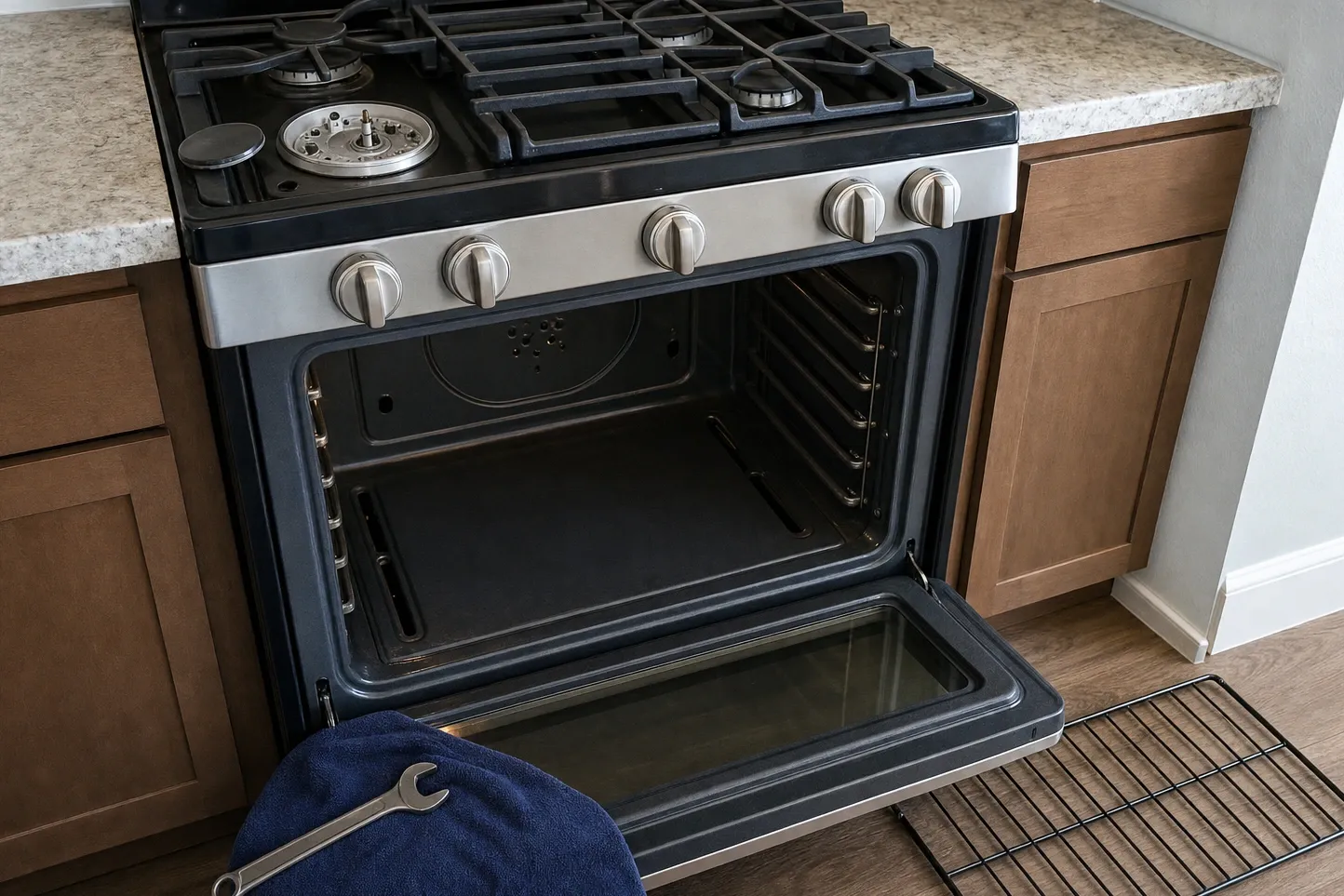
Nearly every Viking oven replacement part that fails in ordinary use, whether a bake or broil element, a gas igniter, a temperature sensor, a door gasket or a control board, can be changed with the oven still sitting in its cabinet, and in most cases that is the better use of your money. Element and thermostat work typically falls in the $190–$440 range and a control board or touch panel in the $420–$700 range, against $7,360–$15,710 for a comparable new Viking. The part alone rarely settles the question. The oven’s age, how many times it has already been repaired and what it would take to fit a new built-in into your kitchen are what decide it.
The parts that fail, and what they typically cost
Viking builds its gas and electric ovens differently, so the list of likely parts depends on which one you own. On a 5 Series gas range, the oven is heated by a single 30,000 BTU U-shaped bake burner below and a Gourmet-Glo infrared broiler above, and SureSpark ignition lights both of them. Electric ovens rely on bake and broil elements plus the Vari-Speed Dual Flow convection system, which adds a fan motor to the list of things that can wear out.
| Part | What you tend to notice | Typical range |
|---|---|---|
| Bake or broil element | Oven stays cool or heats from one direction only; the element may show a blister or a break | $190–$440 |
| Temperature sensor or thermostat | Food burns or comes out raw although the dial is set correctly | $190–$440 |
| Igniter or burner assembly | Clicking with no flame, or a long delay before the gas catches | $190–$440 |
| Control board or touch panel | Blank display, ignored buttons, settings that drop out | $420–$700 |
Door gaskets, hinges and convection fan motors wear too, and those are priced once the technician has seen which version your oven takes. Every figure above is a typical range, and the firm quote follows the diagnosis, because one symptom can come from more than one part. A cold oven might have a burned-out element, or it might have a sensor reporting the wrong temperature to the controls. Our oven heat series explains how to separate those two.
Read the identification plate before you order anything
Viking parts are matched to the model and serial number, not to how the oven looks, and two ranges that seem identical can take different boards or burners. Where the plate lives depends on the product:
- 5 Series and 7 Series electric wall ovens: on the plate at the top left of the door opening, just under the control panel.
- 7 Series ranges: open the oven door and look beneath the control panel for the label.
- 5 Series freestanding gas ranges: the plate can be in three spots, so lift the left-front grate and check the side panel beneath its support or the burner bowl, then look at the face frame just below the controls, and finally above the oven door under the panel.
- Tuscany dual fuel ranges: slide out the storage drawer and look at the inside wall of the range.
Take a phone picture of the plate and keep it. It spares everyone a second trip if a part needs ordering, and it also reveals how old the oven is.
How old is the oven, and is any of it still covered?
The first six digits of a Viking serial number record the build date in month, day, year order. Viking’s published example, 082421C10019872, decodes to August 24, 2021. That date matters for two reasons.
The first is warranty. Viking’s indoor warranty covers ranges and ovens in full for two years of normal home use, counted from the purchase date or from the closing on new construction, whichever is later. From year three through year five, coverage narrows to parts only on a short list that includes gas burners and electric elements, with the owner paying labor and shipping, and ignition systems are not on that list. If the oven came with a house you bought, the coverage passed to you with the sale, and without a receipt or registration the build date in the serial counts as the start.
The second is the decision itself. An oven inside that five-year window with a dead element is a straightforward repair. One built fifteen or twenty years ago calls for a closer look, which is what the next section is for.
Four questions that decide repair or replace
Which part failed?
An element, sensor or igniter is a contained repair in the $190–$440 band, and on an otherwise sound oven it is nearly always worth doing. A control board at $420–$700 still comes to less than a tenth of the price of a new oven, but it is the part to weigh more carefully on an oven that is already showing other faults.
How often has it failed?
A single repair across ten years says the oven is healthy. The same element replaced twice in two years suggests something is killing it, frequently a loose or scorched connection where the wires meet the terminal, and fitting a third element without finding that cause throws money away. In Venice and Playa Vista, where salt air off the ocean reaches into the kitchen, corrosion on those terminals is one cause worth ruling out. Several different parts failing within a short stretch is the plainest sign an oven is nearing the end.
Parts you can change yourself, and the ones to leave alone
A worn door gasket and an oven light bulb are fair owner jobs once the oven is cold and the power is off at the breaker. On some models the electric elements come out with a couple of screws, but the wires behind them carry full 240-volt current and the terminals bend or snap easily, so shut off the circuit and photograph the connections before you touch anything. Anything on the gas side, including SureSpark ignition parts and burner work, and any control board belongs with a technician, since a slip there means a gas leak or a board ruined by a miswired harness. If the oven keeps tripping the breaker, stop resetting it and read why a Viking oven trips the breaker first.
What the $89 visit settles
Buying parts on a hunch is the costly way to fix an oven. A single flat $89 brings a technician to your kitchen to test the elements, sensor, ignition and controls and to name the part that has actually failed. Approve the repair and that $89 comes off the bill. If the diagnosis shows the oven is not worth saving, you learn that before spending anything on parts. We are an independent service that is not affiliated with Viking, working across Woodland Hills, Westwood, Venice and Playa Vista. Call (213) 652-7030 or use the booking button on this page, and if you are in the west Valley, our page on Viking repair in Woodland Hills covers that area.
Follow-ups
Where is the model number on a Viking wall oven?
On 5 Series and 7 Series electric wall ovens it sits on the identification plate at the top left corner of the door opening, directly beneath the control panel. Open the door fully and look up and to the left. A phone photo of that plate is the easiest way to read the small print and keep it handy for ordering parts.
Does Viking still pay for oven parts after the first two years?
Partly, from year three through year five. In that window Viking supplies certain parts, electric elements and gas burners among them, while the owner covers labor and shipping. Ignition systems, burner bases and caps are left out, so check the build date in the serial to see which window your oven is in.
Is a new control board worth it on an older Viking oven?
Usually yes, provided the rest of the oven is sound. A control board or touch panel typically runs $420–$700, a small fraction of the $7,360–$15,710 a comparable new Viking costs, and the cabinet opening stays untouched. Think harder if the oven has needed several other repairs lately or the board for your model has become hard to find.
How do I work out the age of my Viking oven?
Read the first six digits of the serial number on the identification plate, which give the build date as month, day and year. Viking's own example, serial 082421C10019872, was built on August 24, 2021. That build date also becomes the warranty start if you have neither a receipt nor a registration.